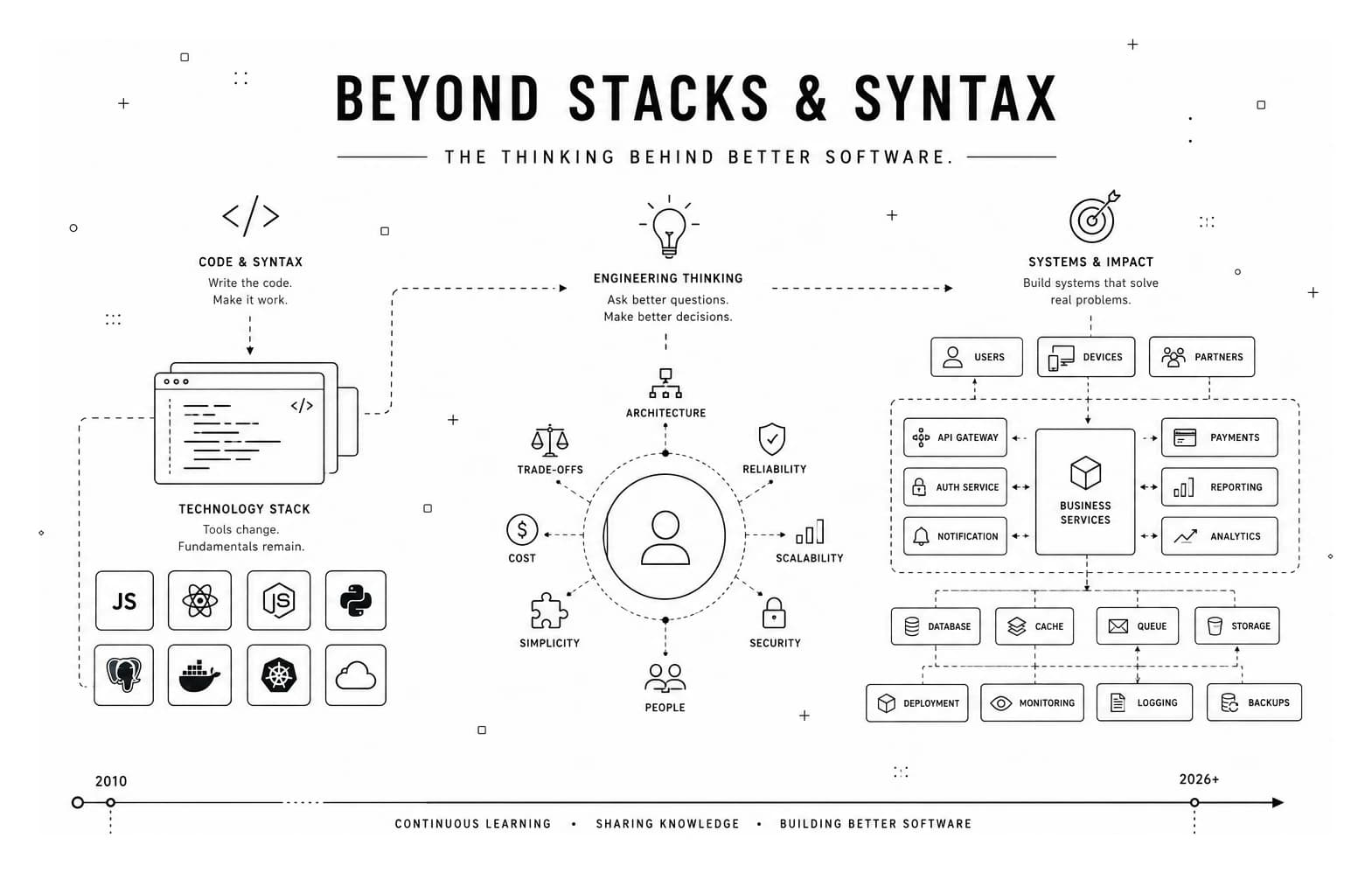
Technologies change constantly. Languages evolve. Frameworks come and go. Infrastructure changes. Architectural patterns move in and out of favour.
But many of the fundamental engineering problems stay exactly where they are.
How should a system be structured? Where should responsibilities live? How much complexity is justified? When should something be separated into another service? What happens when part of the system fails? How do we make software easier to maintain?
And occasionally the most useful question of all: when is the technically impressive solution actually the wrong solution?
What the name means
Beyond is about looking past the immediate implementation. Beyond the ticket. Beyond the function. Beyond the API. Beyond the framework. Beyond whether something simply "works." The interesting questions usually begin after that point, not before it.
Stacks are the tools we build with — languages, frameworks, databases, infrastructure, cloud platforms, development tools. They matter, and they are also constantly changing. Good engineering thinking should survive those changes.
Syntax is how we tell computers what to do. But knowing how to write code is only one part of software engineering. Understanding what should be built, why it should be built that way, and how it fits into a larger system is where the work gets genuinely interesting.
Put together, the name is one idea: software engineering is about more than the technologies we use and the code we write. It's about systems, decisions, trade-offs, failures, people, constraints, and continuous learning.
What I'll write about
Some posts will explore architecture or system design in depth. Others will focus on development practices, infrastructure, databases, APIs, security, AI, engineering teams, or simply an interesting problem I ran into while building something.
Broadly, six areas:
- Engineering — APIs, databases, testing, debugging, performance, maintainability, technical debt.
- Architecture — service boundaries, modular monoliths, distributed systems, event-driven design, integration patterns.
- Infrastructure — containers, CI/CD, cloud, deployment, monitoring, incidents, recovery.
- AI — AI-assisted development, LLM integration, and what any of it means for engineering judgement.
- Engineering thinking — simplicity versus complexity, build versus buy, over-engineering, designing for change.
- Teams — code review, mentoring, documentation, ownership, the balance between speed and quality.
How I'll try to write
A few principles I want to hold myself to.
Practical over theoretical. Theory earns its place when it helps solve a real problem. I'll try to connect concepts to situations I've actually been in.
Explain the why. Not just how something works, but why you'd use it, why you wouldn't, what problem it actually solves, what it costs, what the alternatives are, and when the decision stops making sense.
Trade-offs over absolutes. Software engineering rarely has universal answers. I'd rather write "this worked well under these constraints, and here's why" than "this is the correct architecture." A lot of architecture is really about choosing which problems you're willing to live with.
Experience over authority. I'll share what I've seen work without pretending it's how software should be built everywhere. Different teams operate under different technical, organisational, financial and historical constraints.
Simplicity matters. Complexity should have a reason to exist. Don't introduce it until the problem justifies it.
Production changes everything. A system running locally is software. A system running reliably for real users is a different engineering problem entirely — reliability, observability, deployment, security, performance, failure, recovery, data, operations, maintainability.
Stay curious. Experience should produce better questions, not fewer of them. Opinions should move when the evidence does.
What this isn't
This isn't going to be another site explaining how to create an Express API in ten minutes. Not because that's not useful, but because it's already covered thoroughly elsewhere.
I'm more interested in the article after that one. Not "10 Reasons Everyone Should Use Kubernetes" but "When Kubernetes Becomes More Infrastructure Than You Need." Not "How to Build Microservices" but "Why Our Express API Eventually Needed Service Boundaries."
The second version of each of those encourages engineering thinking. That's the part I want to write about.
The bar
A good article here should leave you thinking: I hadn't thought about it that way.
You don't have to agree with me. The goal isn't to hand anyone a rule. It's to offer another perspective you can apply to your own decisions — and, ideally, to give you better ways to think about the problem rather than a definitive answer to it.
That's the whole idea.
I'm still learning too, and that's very much part of the point.
Tags
engineeringwriting